Early childhood development · ages 3–8
Help every child’s development get seen, and supported, sooner.
Levian Health builds play-based tools for young children and the people who care for them. Children learn through a game they love. With a parent’s consent, that play also builds a careful picture of how they’re growing, so families and clinicians can act earlier.
Built in collaboration with researchers at Stanford.
Why we started
It began with one family that waited years for an answer.
“A parent noticed something early. It took years, and a long line of appointments, before anyone could say what it was.”
Our founder grew up alongside a younger brother with an intellectual disability, a learning disability and a global developmental delay. Their mother noticed early. The first doctor said it was nothing.
- A parent noticesSomething seems different, early on.
- “It’s nothing”The first visit to primary care doesn’t lead anywhere.
- Five to seven specialistsReferral after referral, each starting from scratch.
- A diagnosis, years laterAnd by then, the best window for early support has narrowed.
That family was one of the lucky ones: they got an answer. Levian exists so the next family doesn’t have to be lucky.
The problem
The system meant to catch these children early is stretched thin.
U.S. children living with a developmental, behavioral, cognitive or learning disorder.
Kennedy Krieger Instituteof U.S. autism centers surveyed had waits longer than four months for a diagnostic evaluation. About 15% waited over a year, or had stopped taking referrals.
Krafta et al., 2023 surveyof autistic children were flagged by the standard toddler screening questionnaire in a 25,999-child primary care study, with lower accuracy for girls and children of color.
Guthrie et al., Pediatrics 2019Screening is a one-time snapshot, waiting lists are long, and parents often arrive at appointments without the information clinicians need. We think the answer starts with something children already want to do: play.
Our approach
Learning first. Understanding over time. A clear path to care.
We build products that are good for children on their own terms, and careful enough to be useful to the people who support them.
Learn through play
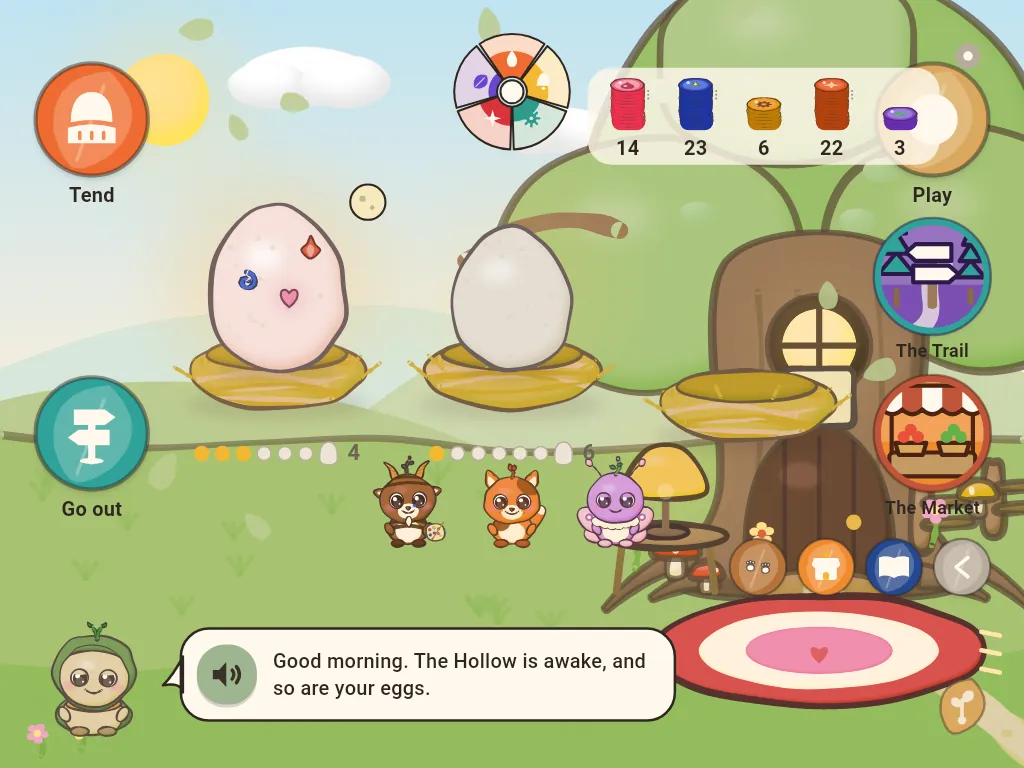
Our first app is a gentle game for ages 3 to 8. Children raise creatures by reading, counting, drawing, exploring and practicing feelings, often away from the screen.
- Short sessions with a real ending each day
- No ads, no purchases, no streaks to keep
- Built on established early-learning standards
Understand over time
Inside each activity is a version of a task researchers already use to study development. Patterns only count once they repeat across weeks, never from a single session.
- Five developmental domains, tracked by age in months
- Confidence and completeness shown with every score
- Parents see strengths and one idea to try, never a label
Connect to care
When a parent chooses to, they can share a structured developmental summary with their child’s clinician, so the first appointment starts with evidence instead of from scratch.
- Opt-in, parent-controlled sharing
- The behaviors behind every note, in plain language
- Clearly marked as not a diagnosis
For clinicians and researchers
Interpretable measures, held to a strict standard before they mean anything.
Every activity reports a visible learning score to the child and quietly records one or more developmental indicators. The indicators are human-readable features, each documented and tied to an established task.
Sociability
Emotion recognition by complexity, response to name, gaze to faces, turn-taking.
mdw.response_to_name
Flexibility
Accuracy after a rule switch, perseverative errors, recovery from surprise. Based on DCCS.
trl.post_switch_accuracy
Regulation
Waiting, small-now versus large-later choices, sustained attention, frustration recovery.
bur.frustration_recovery_ms
Communication
Nonword repetition, picture naming, rhyme and first sounds, sentence length in retells.
lib.nonword_repetition
Motor & praxis
Tracing smoothness and deviation, shape copying, tapping precision, two-handed timing.
wsh.trace_deviation_rms
How a signal earns its place
- 01
Sampled twice, a week apart. No indicator counts from a single session.
- 02
Low-quality sessions are discarded. They’re flagged and dropped, never guessed.
- 03
Normed by age in months. Separately by sex only where the literature supports it.
- 04
Scores carry uncertainty. Each domain shows a confidence interval and how complete the data is.
- 05
Patterns must persist. A note appears only when a profile holds across two sessions two weeks apart.
- 06
Processed on the device. Camera and microphone features are computed locally, and only with a guardian’s consent.
Validation plan
- NowFeasibility
Families play at home. We measure completion, return, session length and test-retest reliability, and cut any indicator below ICC 0.5.
- Phase 1Concurrent validity
About 60 children complete established tasks (DCCS, NEPSY-II, CTOPP-2, Beery VMI, MABC-2 and others) alongside the game version. Target r ≥ 0.5 per indicator.
- Phase 2Accuracy at real prevalence
About 300 children, half with an existing or suspected diagnosis. Sensitivity, specificity, PPV and NPV, stratified by group.
- Phase 3Schools and clinics
Deployment where children already are, with teacher and clinician reports.
Planned throughout: IRB oversight, COPPA-compliant guardian consent, pre-registration, and STARD-AI reporting. Our products today are learning tools with developmental insights for parents. They are not medical devices and do not diagnose any condition.
Privacy by design
Children’s data is a trust we earn every day.
These aren’t settings we might change later. They’re built into how the product works.
Only a parent or guardian creates an account, after reading and agreeing to a plain-language consent summary.
Every activity works without them. If a parent turns them on, they’re used only during the activities that need them.
No ads, no tracking, no third-party analytics, no in-app purchases. Recordings are never sold.
A nickname and birth month for the child. Never a surname, school, photo or location.
Parents can copy all of their child’s data, or delete it from the device and our servers.
Data is encrypted on the device. Crash reports carry no child identifiers and no screenshots.
Work with us
We’re looking for people who want to see children earlier.
Tell us what a useful referral summary looks like, and help shape the clinician report.
Collaborate on validation studies, indicator definitions and longitudinal analysis.
Pilot the app with families in your program.
We’re always happy to talk about where this is going.
Prefer email? Write to jasjeev@levian.health.
Are you a parent? Join the family waitlist instead.